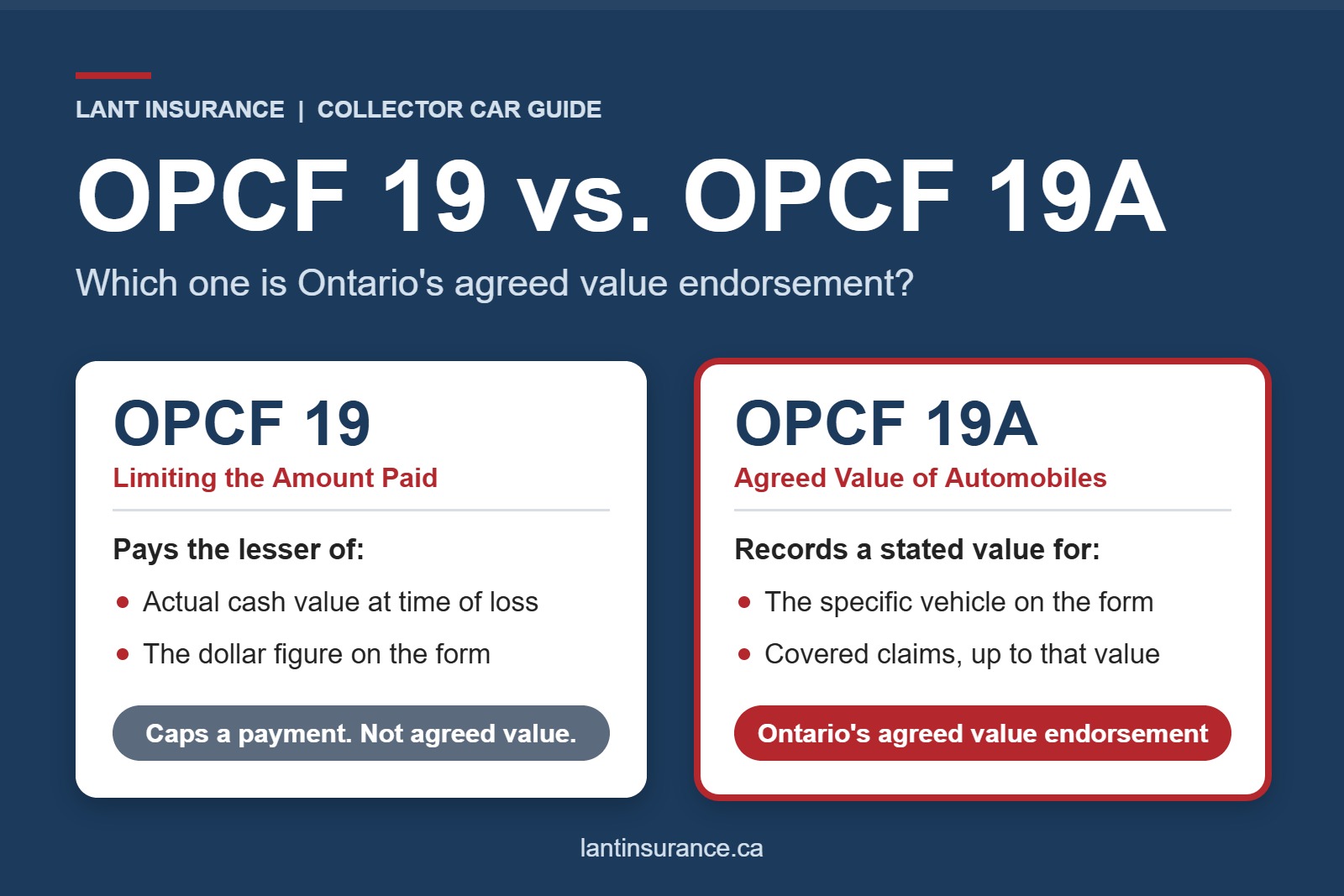
The names OPCF 19 and OPCF 19A look almost the same, but they do very different jobs. That single letter matters when you insure a classic, collector, restored or modified vehicle in Ontario.
Here is the key point: OPCF 19 is a limiting endorsement, not an agreed value endorsement. Ontario’s regulator lists OPCF 19 as Limiting the Amount Paid for Loss or Damage Coverages and OPCF 19A as Agreed Value of Automobiles in its list of approved policy change forms. The current OPCF 19A form says its purpose is an arrangement about the value of the automobile.
So if you want the value of a special vehicle agreed before a covered loss, ask about OPCF 19A, not just “OPCF 19.” This guide explains the difference in plain language, how a normal Ontario policy settles a claim, and what to check before you rely on an agreed amount.
The quick answer: OPCF 19 does not create agreed value
What OPCF 19 is designed to do
OPCF 19 is titled Limiting the Amount Paid for Loss or Damage Coverages. It caps what the insurer will pay under Section 7, the optional Loss or Damage section of an Ontario auto policy.
The form’s own wording makes the effect clear. You agree that the insurer will not pay more than the actual cash value at the time of the loss, or the dollar figure written on the form, whichever is less. The coverage is still subject to the deductible on your Certificate of Automobile Insurance.
Read that again, because it is the opposite of what many people expect. OPCF 19 cannot pay you more than actual cash value. It can only pay less. It does not set a protected value for a special vehicle.
What OPCF 19A is designed to do
OPCF 19A is the form called Agreed Value of Automobiles. It records the value of the specific automobile shown on the form. In certain circumstances the insurer agrees to pay that amount and gives up its right to pay actual cash value instead.
The form replaces section 7.7 of the Ontario Automobile Policy, “What We Will Pay,” for the vehicle listed. That is why OPCF 19A matters for a collector car. It puts a stated value on the policy before a covered loss, instead of leaving the value to be argued after one, and it is the mechanism behind most agreed-value collector car coverage written in Ontario.
Why the difference matters
Calling OPCF 19 an “agreed value endorsement” can lead to a serious misunderstanding. One form limits what may be paid. The other changes how the car is valued. Before you buy or renew, check the form number and title on the paperwork, not just a verbal description.
How a standard Ontario policy values vehicle damage
Section 7 coverage is optional
Ontario’s standard owner’s policy, the Ontario Automobile Policy (OAP 1), treats Section 7 as optional coverage for loss of or damage to your own car from collision, fire, theft and other insured risks. You only have a particular coverage when it is shown on your Certificate of Automobile Insurance. See the current OAP 1, approved for use on or after July 1, 2026.
This matters because agreed value is not a stand-alone promise to pay for every kind of damage. OPCF 19A works with the Loss or Damage coverage you actually bought, whether that sits on a collector policy or on the everyday auto insurance covering the car in the other half of the garage. The loss still has to come from a peril your policy covers.
Actual cash value and depreciation
Without an agreed value endorsement, section 7.7 of the OAP 1 says the insurer will not pay more than the car’s actual cash value at the time it was damaged or stolen, less the deductible. The value is worked out after taking depreciation into account, and the insurer pays the lower of the repair cost or the actual cash value. Ontario’s statutory conditions for automobile insurance follow the same principle.
Actual cash value is not the original purchase price, and it is not the total you have spent. It is a valuation as at the moment of the loss. For an ordinary daily driver that is often a sensible approach. For a carefully restored or rare car, an owner may worry that a post-loss valuation will not reflect documented restoration work, rarity or condition.
A collector car does not get agreed value automatically
Owning an antique or collector vehicle does not create an agreed value settlement on its own. A car can be old, rare and expensive to restore and still be settled under the normal actual cash value rule, unless the policy says otherwise. The certificate, the endorsements and the insurer’s current wording are what count.
A historic vehicle plate does not change this either. It is a registration status, not an insurance policy, as we explain in our guide to historic vehicle plates in Ontario and what they mean for your coverage.
If the two valuation methods are still blurring together, our guide to agreed value versus actual cash value walks through what each one pays out on a real claim.
How OPCF 19A agreed value works
The stated amount is tied to one specific vehicle
The OPCF 19A form identifies the automobile by model year, make and model, and serial number or VIN. It then shows a value, including taxes where they apply. The insurer agrees to pay up to that value under Section 7 when loss or damage is caused by a peril you are insured against.
So the agreed amount must be attached to the right car. Check the year, make, model and VIN as well as the figure. Do not assume that a recent appraisal, a photo folder or a stack of restoration invoices has changed anything, unless the insurer has actually issued the endorsement or another written policy change.
“Up to” does not mean every claim pays the full amount
Agreed value does not mean that every small or medium repair produces a payment for the whole figure on the form. The wording says the insurer will pay up to the stated value. For a repairable loss, the repair cost can be far below that ceiling.
The form also says the insurer will not pay more to repair the car than the value shown. And the OAP 1 keeps the insurer’s right to repair, replace or rebuild in appropriate circumstances. OPCF 19A changes the valuation rule in section 7.7. It does not remove the rest of the policy. The form states that all other terms and conditions stay the same.
There is a useful clause about parts
One line in OPCF 19A is worth knowing if you own something rare. If a part needed to repair the car is no longer available, the form says the insurer will pay an amount equal to the manufacturer’s latest list price for that part.
That does not solve every sourcing problem, but it is a real provision, and it is one more reason to read the form itself rather than a summary of it.
Deductibles still apply
OPCF 19A does not erase your deductible. The form says the coverage is subject to the loss or damage deductibles shown on the Certificate of Automobile Insurance. If the stated value is $75,000 and a covered total loss is settled under Section 7 with a $1,000 deductible, that deductible is still part of the calculation.
Ask whether the amount on the form includes applicable taxes, and confirm the deductible for each relevant coverage. A clear answer before a loss is much easier than a dispute after one.
A simple comparison
Normal OAP 1 section 7.7. Uses actual cash value, after depreciation. Pays the lower of the repair cost or the actual cash value, less the deductible.
OPCF 19. Pays the lower of actual cash value or the figure written on the form, less the deductible. It caps the payment; it does not protect a value.
OPCF 19A. Sets an agreed value for the listed automobile for certain covered Section 7 claims, subject to the form wording and the applicable deductibles.
What happens when another driver is at fault
Direct Compensation – Property Damage changes the claim path
In Ontario, a collision with another insured Ontario vehicle can be handled under Direct Compensation – Property Damage (DCPD) coverage. The OAP 1 says this coverage may pay for damage to your car when you or your driver were not entirely at fault, subject to the policy conditions. The standard policy uses actual cash value for this type of claim. None of this crosses provincial lines, so if you are pricing or garaging a car in Quebec, the forms and the fault rules behind car insurance costs in Montreal work on a different system and an Ontario endorsement will not follow the vehicle there.
Do not assume that “the other driver was at fault” makes the valuation question disappear. The coverage section, the degree of fault, the deductibles and the endorsements all affect how the loss is handled. Ontario drivers can also opt out of claiming under DCPD using OPCF 49, and that choice matters here, as the next section explains.
OPCF 19A can cover a shortfall in limited circumstances
The current OPCF 19A form has a specific DCPD provision. Where the amount payable under DCPD is less than what would have been payable under the agreed value section, the insurer will pay the difference. But three conditions apply:
- you must not have elected out of recovering damages under DCPD;
- you must have purchased All Perils or Collision or Upset coverage; and
- the amount paid does not include the DCPD deductible that applies to the claim.
This is technical, but it is important. It is a good reason to review the whole coverage package rather than looking only at the agreed value figure.
Why agreed value matters for classic and restored cars
The value may not follow ordinary depreciation
An older car can gain value after a careful restoration. A rare or limited-production vehicle may never follow a standard depreciation curve at all. An agreed value discussion lets the owner and the insurer settle the value question before a covered loss, rather than debating it once the car is damaged or stolen.
That does not mean every vehicle needs OPCF 19A. The right fit depends on the car, how it is used, what the insurer offers and the value you can support with evidence.
Keep the supporting records current
Good records make a value discussion much easier. Keep clear photos, restoration invoices, purchase documents, parts receipts and any appraisal the insurer asks for — our five tips for getting an accurate appraisal on your classic car cover the documentation a valuer will expect to see. If you finish a major restoration, add expensive modifications or see a real change in market value, speak to your broker before the next renewal.
The form, not your own estimate, is the agreement. Make sure the policy reflects the value you and the insurer have accepted.
How to set up or review agreed value coverage
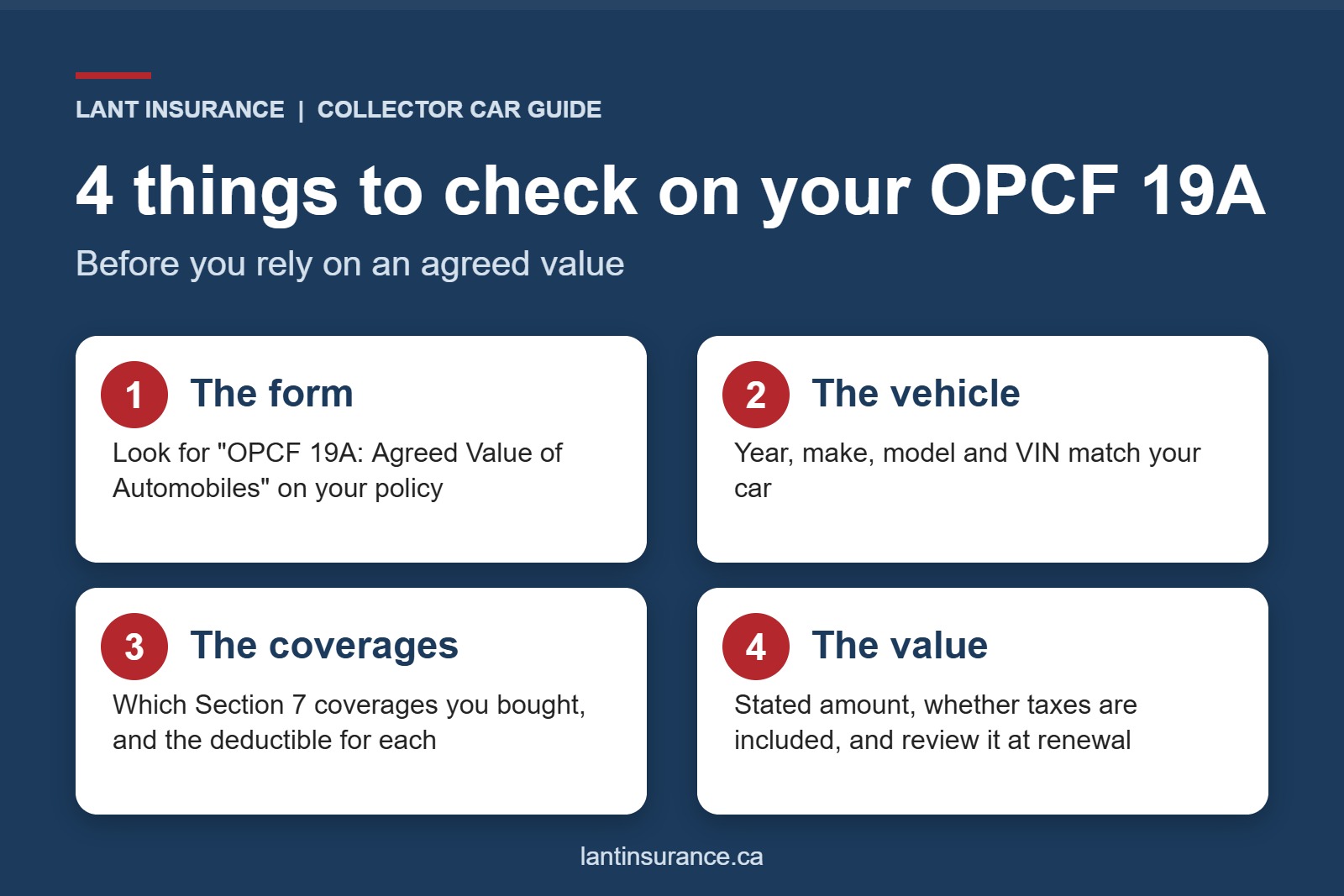
1. Check the certificate and endorsements
Look for the exact wording OPCF 19A: Agreed Value of Automobiles. Confirm that the vehicle is correctly identified and that the stated value is visible. If all you can find is an appraisal in your own file, ask whether an endorsement was ever issued.
2. Check the physical damage coverages
Ask which Section 7 coverages are on the car: Collision or Upset, Comprehensive, Specified Perils or All Perils. Agreed value does not create coverage for a peril you did not buy. Confirm the deductible for each coverage as well.
3. Ask how the value was set and what it includes
Ask whether the amount includes applicable taxes, documented restoration work and the equipment or modifications that matter to you. The OAP 1 has separate limits for some electronic accessories and equipment, so it is wise to ask how non-factory items are treated under your policy.
4. Review the amount after any meaningful change
Review the stated value at renewal, and sooner if the car changes materially. A new engine, a completed restoration, a major repair, newly installed equipment or a big market shift can all make an old figure less useful. The start of show season is a natural prompt, so check the stated value while you are running through the rest of your pre-show insurance checklist. Do not wait for a claim to find out that the agreed amount is out of date.
Do not confuse OPCF 19A with OPCF 43
OPCF 43 is another Ontario endorsement that causes confusion. FSRA describes it as Removing Depreciation Deduction in the event of a total loss. It is not the agreed value form. See FSRA’s OPCF 43 page for its current purpose.
The names sound related because both affect claim valuation, but they answer different questions. One removes a depreciation deduction in the circumstances set out in its own wording. The other records an agreed value for a listed automobile. They are not substitutes for each other.
Questions to ask before you rely on an agreed value
Before you insure or renew a special vehicle, ask these in writing:
- Does my policy include OPCF 19A, and which automobile does it apply to?
- What value is shown, and does it include applicable taxes?
- Which loss or damage coverages and deductibles apply to this vehicle?
- How would a not-at-fault collision be handled under DCPD and OPCF 19A?
- How are custom parts, restoration work and non-factory equipment treated?
- When should the agreed value be reviewed or updated?
For an everyday vehicle, you can also review our auto insurance options to make sure the coverage matches how the car is really used.
Conclusion
OPCF 19 and OPCF 19A should never be treated as the same thing. OPCF 19 caps a Section 7 payment at the lower of actual cash value or a stated figure. OPCF 19A is Ontario’s agreed value endorsement.
For a collector, classic, restored or modified car, that difference can be expensive. Check that the correct form is on the policy, that the listed value is current, that the right physical damage coverages are in place, and that you understand the deductibles. If you would like help reviewing coverage for a special vehicle, talk to a broker at Lant Insurance. This article is general information only; your own policy wording, certificate, endorsements and claim facts govern.
Frequently asked questions
Is OPCF 19 an agreed value endorsement?
No, OPCF 19 is a limiting endorsement, and it can only reduce what is paid. OPCF 19A is Ontario’s agreed value endorsement. Always check the form number and title on your policy rather than relying on a short verbal description.
Does OPCF 19A guarantee the full stated value after every claim?
No, the form says the insurer will pay up to the value shown, and it will not pay more than that value to repair the car. A smaller repair claim is settled for the covered repair cost, and the insurer keeps its policy rights to repair, replace or rebuild. The loss must also be caused by a peril you are insured against.
Do I need Collision or Comprehensive coverage for OPCF 19A to matter?
OPCF 19A works with your Section 7 Loss or Damage coverages; it does not add coverage for a peril you did not buy. Its DCPD difference provision applies only if you have purchased All Perils or Collision or Upset coverage. Ask your broker to confirm the full package.
Does the deductible apply to an agreed value claim?
Usually, yes the OPCF 19A form says the coverage is subject to the Section 7 deductibles shown on the Certificate of Automobile Insurance. Confirm the applicable deductible before you rely on the stated value.
Does agreed value apply if another driver caused the collision?
It can still be relevant because a not-at-fault Ontario collision may be handled through DCPD. OPCF 19A can pay the difference in limited circumstances, but only if you have not elected out of DCPD and you have bought All Perils or Collision or Upset coverage.
Is OPCF 19A only for classic or collector cars?
No, the form is not limited to classic vehicles. It may be considered for any automobile where the insurer agrees to a stated value. Whether it is available or suitable depends on the insurer’s underwriting rules and the car itself.
Does an appraisal automatically give my vehicle agreed value coverage?
No, an appraisal can support a value, but it does not change the insurance contract by itself. Check that OPCF 19A has been issued and that it lists the correct vehicle and the correct amount.
What is the difference between OPCF 19A and OPCF 43?
OPCF 19A is the agreed value endorsement for a listed automobile. OPCF 43 is a different endorsement that removes a depreciation deduction in the total loss circumstances set out in its own wording. They solve different problems and are not interchangeable.
Leave a Reply